- Date:
Infocus - An inquiry into a breach of Covid-19 lockdown rules at 10 Downing Street threatens to bring the UK Prime Minister down. Boris Johnson has lost credibility and support from fellow Conservative Members of Parliament, causing the toughest political crisis since his election in 2019.
An inquiry into a breach of Covid-19 lockdown rules at 10 Downing Street threatens to bring the UK Prime Minister down. Boris Johnson has lost credibility and support from fellow Conservative Members of Parliament, causing the toughest political crisis since his election in 2019. In this issue of Infocus, Joaquin Thul looks at the next steps and possible policy implications for the UK government.
Over the last month the UK government has faced allegations of multiple parties and gatherings held at 10 Downing Street while the country was subject to strict lockdown restrictions. Prime Minister (PM) Boris Johnson admitted attending an outdoor party at his residence in 2020, which prompted an inquiry led by Sue Gray, a senior civil servant, to establish the nature of these meetings and an investigation from the London Metropolitan Police to assess if these alleged parties were in potential breach of the law.
The results of Gray’s report were published this week and noted “failures of leadership and judgement” at Downing Street and the Cabinet Office. According to the report, these were difficult to justify in the context of the pandemic and should not have been allowed to take place. Although it does not reference specific people, the report highlights a serious failure by government officials to observe the rules at the time.
Regardless of whether the PM or his staff were in breach of restrictions at the time, these allegations have triggered a rapid decline in public support for Johnson. According to a survey by Politico, voting intentions for the Conservative party have fallen from 51% at the start of the pandemic to 32% at the time of the latest poll, the worst result since Johnson won the Conservative party leadership in July 2019.
Rise and fall in support for Boris
After winning the party leadership, Boris Johnson called a snap election in December 2019. In that election the Tories received 43% of the popular vote, the highest share for any party in the UK since 1979, and won many supposedly safe Labour Party seats.
Less than three years later, the allegations over breaches of Covid-19 rules have pushed some Conservative Members of Parliament (MP) to withdraw their support for Johnson, openly calling for his resignation, submitting letters of no confidence and one even defecting to the Labour Party.
Conservative Party rules hold that if 15% of its MPs – 54 at present – submit a no-confidence letter, a leadership election must be held. If triggered, a secret ballot will be held and Johnson would need the backing of at least half of the Conservative MPs, or 181, to remain as Party leader. If he wins, another leadership challenge cannot be triggered for a year. However, if he were to lose there would be an internal leadership contest from which Johnson would be excluded.
Will Boris leave?
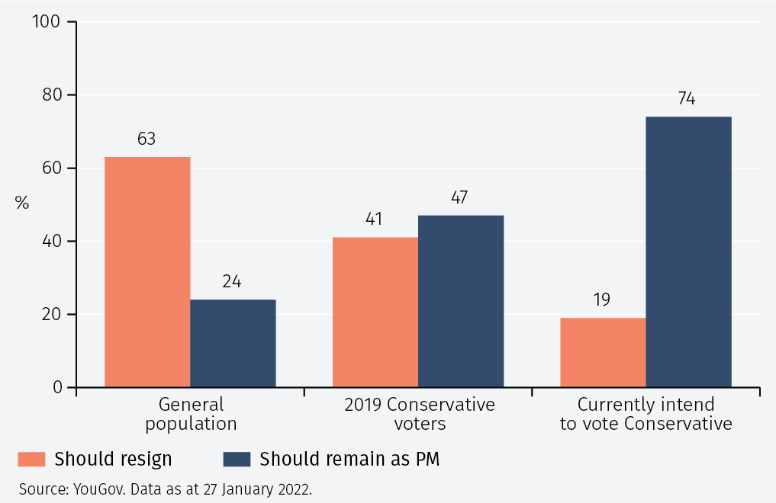
Despite the uproar over the allegations, Johnson remains a strong figure with Conservative Party voters. A recent YouGov poll showed that despite the fact that over 60% of the general population think he should resign, 47% of those who voted Conservative at the 2019 election and over 70% of those who intend to vote Conservative believe he should remain as PM (see Figure 1).
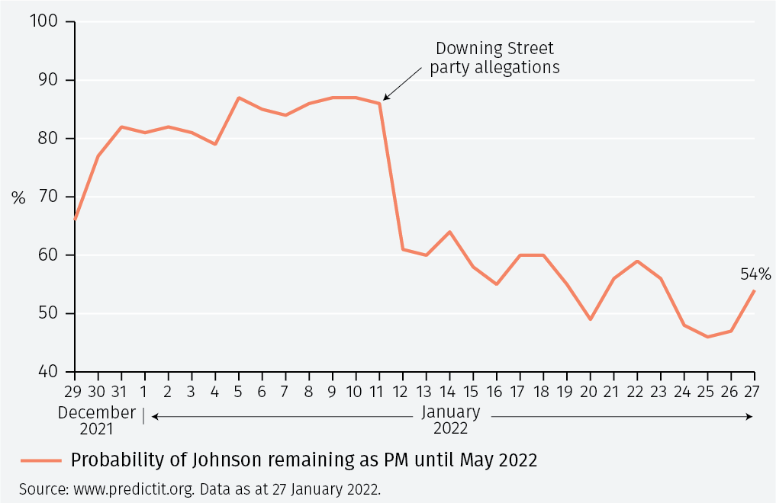
A further complication is that Johnson’s opponents do not have a strong candidate they can rally around as a potential replacement. Figures such as Liz Truss, Foreign Secretary, and Rishi Sunak, Chancellor of the Exchequer, are among those sometimes proposed as potential replacements. As of February 2nd, the bookmakers’ odds of Rishi Sunak becoming the next Conservative leader were 21/10, which represents an implied probability of 67.7%, while those for Liz Truss are 6/1, a probability of 14.3%.1 Both have been among Johnson’s closest allies and prominent members of his cabinet. Moreover, since the party allegations were leaked in early January 2022, the probability of Johnson staying as Prime Minister until May has fallen (from 85%) but still remains over 50%, see Figure 2.2
Asset prices have been little affected by the potential change in leadership. Sterling has depreciated by about 1% against the US dollar, in line with other developed currencies, while yields on 10-year UK government bonds have risen to 1.25% reflecting expectations of tighter monetary policy. The UK had one of the best performing equity markets in early 2022, benefiting from the global rotation towards value stocks (which have a high weight in the main UK market indices).
Implications for policy
A potential change in leadership is not expected to trigger a change in economic policy. Questions have been raised over Johnson’s lack of judgement for allowing and participating in these gatherings, but not over his flagship policies. In summary:
- Even if Johnson resigns as PM, the UK’s post-Brexit policies are unlikely to be reversed in the short term. The UK trade deal with Brussels was approved by the House of Commons in December 2020 by 521 votes to 73, with the support of MPs from both Conservative and Labour parties. Moreover, Keir Starmer, leader of the Labour party, recently expressed his party’s intention of making Brexit work for the UK and not reversing some of the points already agreed with the EU.3 Policies on trade, immigration and the customs border in the Irish Sea are likely to remain in place. Despite the UK questioning of the oversight of the European Court of Justice over the Northern Ireland Protocol, the EU has also ruled out a renegotiation of the treaty.
- The UK government recently announced its intention to change some of the inherited EU regulations to, in Johnson’s words, “unleash the benefits of Brexit” and cut £1 billion of red tape for businesses.4 The UK had mirrored some of the existing EU regulations to smooth the Brexit process during the transition period that ended in January 2021. Since then, the UK has been reviewing which policies it wants to change. These changes are expected to promote the development of new technologies, help investment and boost employment. However, specific details of these changes are still to be revealed and could potentially be delayed by a change in leadership.
- On 30 January, Johnson and Sunak confirmed the planned increase in the National Insurance tax will go ahead in April 2022, despite the opposition of backbench Conservative MPs. The UK budget deficit has declined thanks to strong revenues from corporation taxes and increased National Insurance receipts as the economy reopened in 2021. These helped offset the almost £15 billion increase in central government spending on healthcare services, debt interest costs and subsidies for the rail industry.5 As of December 2021, year-to-date government borrowing was 46.8% less than in the same period in 2020.6 Therefore, even if betting odds are correct and Rishi Sunak takes over as the next PM, the appointment of a new Chancellor would not have implications on taxes.
- Regardless of a change in leadership, the Conservative party will also face the difficult task of rebuilding voter support in constituencies that feel abandoned by Johnson’s post-Brexit plans. Promoting economic development in the poorest regions of the country has been a key challenge. Conservatives have focused their campaigns on the Midlands and North England, which historically vote Labour, with the risk of losing support from traditional Tory regions. The latest prediction from Electoral Calculus shows that in the event of another general election the Conservative party would lose more than 10% of the votes compared to the 2019 result. Therefore, the recent decline in political support is likely to encourage some Conservative MPs to remove their support for Johnson.
Conclusion
The publication of Gray’s report has reduced Johnson’s support in the House of Commons but might not be enough to remove him from his position as party leader. Despite the decline in general support for the PM, he remains a strong figure among Conservative voters. The lack of a strong candidate that could replace him as PM works in Johnson’s favour.
A potential change in leadership would not be expected to trigger significant change in matters such as taxes, trade or immigration. However, a change of PM could have implications for other areas. First, it would delay the reduction of red tape for businesses and the replacement of some inherited EU rules. Second, it would force the Conservative Party to address the recent loss of political support across the country.
Johnson has urged MPs to wait for the outcome of the Metropolitan police investigation, rejecting calls for him to resign. Regardless of him remaining as PM or not, it is clear his image has been tainted by the allegations that he did not abide by the rules his government was imposing on the rest of the population. This has reduced his credibility, making him an unpopular figure across parts of the British public. However, Johnson is no stranger to controversy and is known for his ability to defy political gravity. The coming weeks will be key for his future.
1 https://www.oddschecker.com/
2 https://www.predictit.org/
3 https://www.ft.com/content/9b01111f-7316-4842-8803-17fc177e95ee
4 https://www.gov.uk/government/news/prime-minister-pledges-brexit-freedoms-bill-to-cut-eu-red-tape
5 https://obr.uk/docs/dlm_uploads/Monthly-PSF-commentary-January-2022.pdf
6 The current UK fiscal year runs between April 2021 and March 2022
Important Information
The value of investments and the income derived from them can fall as well as rise, and past performance is no indicator of future performance. Investment products may be subject to investment risks involving, but not limited to, possible loss of all or part of the principal invested.
This document does not constitute and shall not be construed as a prospectus, advertisement, public offering or placement of, nor a recommendation to buy, sell, hold or solicit, any investment, security, other financial instrument or other product or service. It is not intended to be a final representation of the terms and conditions of any investment, security, other financial instrument or other product or service. This document is for general information only and is not intended as investment advice or any other specific recommendation as to any particular course of action or inaction. The information in this document does not take into account the specific investment objectives, financial situation or particular needs of the recipient. You should seek your own professional advice suitable to your particular circumstances prior to making any investment or if you are in doubt as to the information in this document.
Although information in this document has been obtained from sources believed to be reliable, no member of the EFG group represents or warrants its accuracy, and such information may be incomplete or condensed. Any opinions in this document are subject to change without notice. This document may contain personal opinions which do not necessarily reflect the position of any member of the EFG group. To the fullest extent permissible by law, no member of the EFG group shall be responsible for the consequences of any errors or omissions herein, or reliance upon any opinion or statement contained herein, and each member of the EFG group expressly disclaims any liability, including (without limitation) liability for incidental or consequential damages, arising from the same or resulting from any action or inaction on the part of the recipient in reliance on this document.
The availability of this document in any jurisdiction or country may be contrary to local law or regulation and persons who come into possession of this document should inform themselves of and observe any restrictions. This document may not be reproduced, disclosed or distributed (in whole or in part) to any other person without prior written permission from an authorised member of the EFG group.
This document has been produced by EFG Asset Management (UK) Limited for use by the EFG group and the worldwide subsidiaries and affiliates within the EFG group. EFG Asset Management (UK) Limited is authorised and regulated by the UK Financial Conduct Authority, registered no. 7389746. Registered address: EFG Asset Management (UK) Limited, Leconfield House, Curzon Street, London W1J 5JB, United Kingdom, telephone +44 (0)20 7491 9111.