
- Date:
Inview - In this publication we consider
significant developments in the world’s markets,
and discuss our key convictions and themes for
the coming months.
Editorial
Welcome to the August edition of Inview: Global House View. In this publication we consider significant developments in the world’s markets, and discuss our key convictions and themes for the coming months.
Equity markets have continued to rally in the summer months, supported by various factors. While the rise in US inflation was unexpectedly strong in the spring, investors are increasingly wondering whether it is now peaking. Several things point in this direction. In particular, PCE inflation has been broadly constant and PCE core inflation fell in the second quarter of the year. And commodity prices have recently weakened. Oil prices are about 10 percent off their recent peak and agricultural commodity prices have also fallen. Furthermore, what matters for inflation is the rate of change, typically on an annual basis, and this will most likely moderate in the remainder of 2021 and in early 2022.
It is also true that the very low inflation rates recorded in the spring of 2020 have now dropped out of the 12 month inflation calculation. These base effects are expected to put downward pressure on inflation for several months, although the path towards lower inflation will be volatile.
Market sentiment has also been supported by evidence of ongoing recovery in economic activity. GDP growth exceeded expectations in the second quarter of 2021 and survey data point to a continued solid expansion also in the current quarter. Markets cheered at the positive news, although strong data also carries the risk of an earlier withdrawal of policy support.
The debate about tapering the Fed’s monthly asset purchases is a case in point. The good news, from an investor’s perspective, is that policymakers, from both the monetary and the fiscal side, have made it clear that any policy normalisation will be gradual and data dependent. With respect to US monetary policy, the forthcoming Jackson Hole symposium will likely give Chairman Powell the opportunity the clarify the timeline of policy normalisation.
In Europe, the ECB is in no hurry to reduce support for the economy. Rather, the conclusions of the strategy review presented in July seem to allow for even greater patience before considering a reversal in the current accommodative stance. The new ECB monetary policy strategy clarifies that it will aim for 2% percent inflation instead of the previous target of “below, but close to, 2%”, that in setting policy it will give equal importance to deviations of inflation from the target both on the upside and the downside, and that it will tolerate inflation above the target if needed to recover from protracted economic weakness.
Very accommodative fiscal and monetary policy supports the momentum in global equities. In our view, a moderate overweight to equities is thus warranted within a diversified portfolio, with a preference for US and Asian markets. In contrast, the low level of government and corporate bond yields is unappealing; within fixed income assets, convertible bonds and hybrids are more attractive. Industrial metals and gold have recently corrected and look attractive on a fundamental basis but may be constrained by the rise of the US dollar consistent with expected tapering of asset purchases by the Fed.
Global Asset Allocation: Summary
Equities
- European equities got off to a weak start to the third quarter although have performed better more recently. While there has been some debate on increasing allocation, for now we remain neutral.
- US growth stocks continued to outperform value, while the S&P 500 keeps hitting new highs. Company earnings have largely been upbeat and we remain overweight to the US.
- We continue to look closely at the consumer discretionary sector as it has not yet shown signs of momentum. Both energy and materials have lost their uptrend, confirming our previous cautious view on these sectors.
- There has been some discussion on reducing our Japan overweight but we believe that the low sentiment going into the Olympics could improve on any positive spill over from the games.
- The recent crackdown on large Chinese tech stocks has caused some market unease. However, we stand by our China overweight stance as the overall investment thesis remains broadly unchanged – it is one of the cheapest markets at the moment, supported by a fast recovery in earnings.
Fixed Income
- Despite fears of rising inflation, bond markets rallied and yields declined in July. Within sovereign bonds we would caution against overly long duration positions at least until yields are higher and the yield curve has steepened.
- Investment grade corporate bonds were previously downgraded to reflect the greater sensitivity to rates. A further downgrade has been considered but for now we maintain a neutral position on a risk management basis.
- Recent bank earnings have shown that loan losses so far are not as high as expected and regulators are limiting dividends and buy-backs. With this, we are tactically and strategically overweight preferred and hybrid debt.
Alternative Investments
- The EU recovery fund and a bipartisan infrastructure bill in the US are positives for the asset class so this is an area we are overweight within our alternatives positioning.
- Market volatility may bring opportunities for skillful portfolio managers to enhance performance and alpha streams in their portfolios. This view can be exploited in the directional mandates and alternative LO models.
Currencies
- Following the European Central Bank’s policy review we expect it to remain dovish for longer. Both fundamental and technical indicators suggest that we should no longer maintain our tactical overweight of the euro, leading us to downgrade the currency to neutral.
- The US dollar has strengthened against most developed currencies following recent market activity and concerns over Covid-19 variants. Tactically we remain underweight.
- The UK pound, Australian dollar and Chinese renminbi are amongst our most favoured currencies, supported by signs of economic recovery.
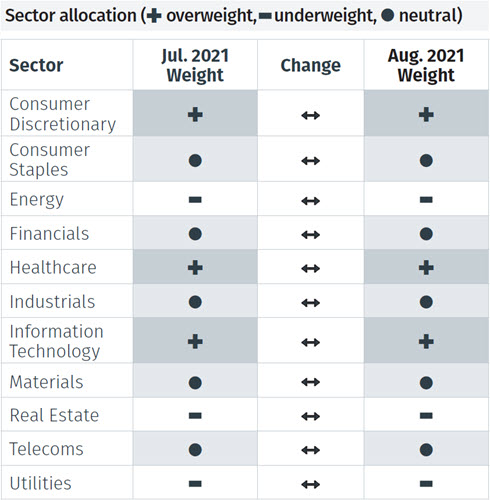
Global Asset Allocation: 12-Month Strategic Outlook
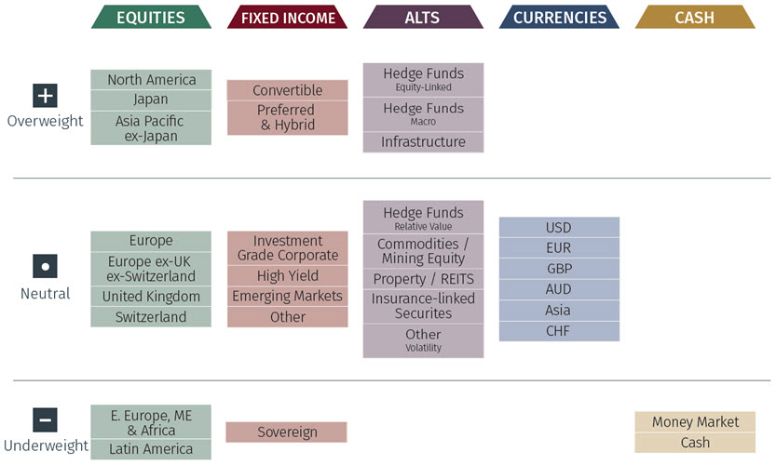
Based on a balanced mandate, the matrix below shows our long-term house view on investment strategy.
Overall Asset Allocation Views
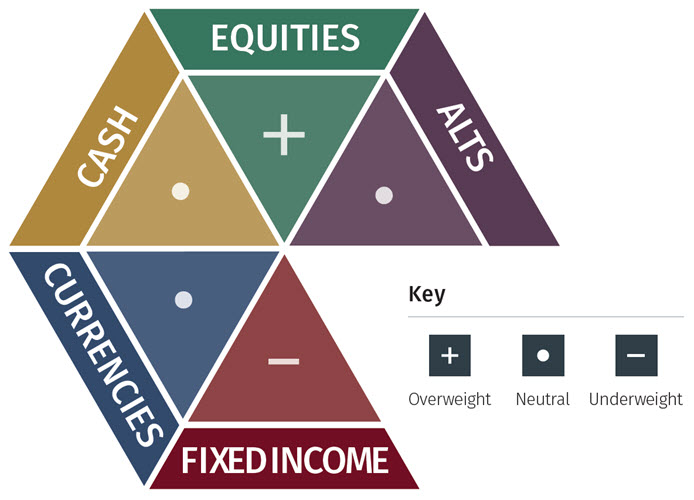
Asset Class Breakdown
Global Asset Allocation: 3-Month Tactical Outlook
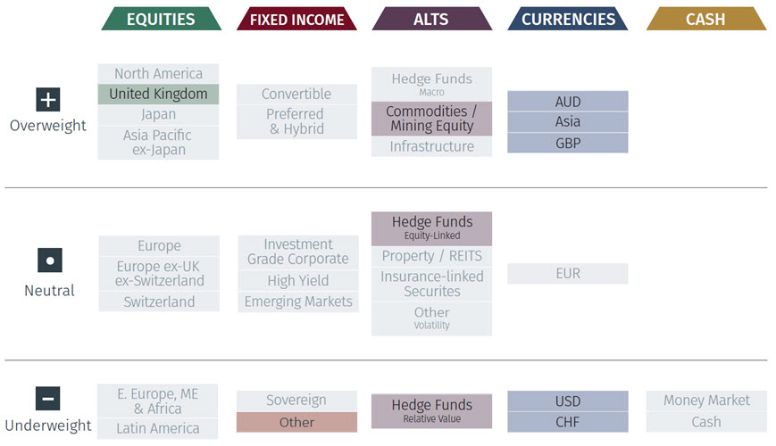
Based on a balanced mandate, the matrix below shows our short-term house view on investment strategy.
Note: The highlighted boxes indicate a difference from our 12-month strategic outlook.
Asset Class Breakdown
Important Information
The value of investments and the income derived from them can fall as well as rise, and past performance is no indicator of future performance. Investment products may be subject to investment risks involving, but not limited to, possible loss of all or part of the principal invested.
This document does not constitute and shall not be construed as a prospectus, advertisement, public offering or placement of, nor a recommendation to buy, sell, hold or solicit, any investment, security, other financial instrument or other product or service. It is not intended to be a final representation of the terms and conditions of any investment, security, other financial instrument or other product or service. This document is for general information only and is not intended as investment advice or any other specific recommendation as to any particular course of action or inaction. The information in this document does not take into account the specific investment objectives, financial situation or particular needs of the recipient. You should seek your own professional advice suitable to your particular circumstances prior to making any investment or if you are in doubt as to the information in this document.
Although information in this document has been obtained from sources believed to be reliable, no member of the EFG group represents or warrants its accuracy, and such information may be incomplete or condensed. Any opinions in this document are subject to change without notice. This document may contain personal opinions which do not necessarily reflect the position of any member of the EFG group. To the fullest extent permissible by law, no member of the EFG group shall be responsible for the consequences of any errors or omissions herein, or reliance upon any opinion or statement contained herein, and each member of the EFG group expressly disclaims any liability, including (without limitation) liability for incidental or consequential damages, arising from the same or resulting from any action or inaction on the part of the recipient in reliance on this document.
The availability of this document in any jurisdiction or country may be contrary to local law or regulation and persons who come into possession of this document should inform themselves of and observe any restrictions. This document may not be reproduced, disclosed or distributed (in whole or in part) to any other person without prior written permission from an authorised member of the EFG group.
This document has been produced by EFG Asset Management (UK) Limited for use by the EFG group and the worldwide subsidiaries and affiliates within the EFG group. EFG Asset Management (UK) Limited is authorised and regulated by the UK Financial Conduct Authority, registered no. 7389746. Registered address: EFG Asset Management (UK) Limited, Leconfield House, Curzon Street, London W1J 5JB, United Kingdom, telephone +44 (0)20 7491 9111.
ASSET ALLOCATION GRIDS
Please use the button below to download the full article to see asset allocation grids.