- Date:
Infocus - Latin America's slow and uneven economic recovery
With the pandemic still ravaging the global economy, public finances remain under stress. The recently released IMF Fiscal Monitor provides a timely update on the outlook for public accounts in this context. In this edition of Infocus, GianLuigi Mandruzzato and Joaquin Thul highlight the key takeaways from the IMF’s analysis. The main conclusion is that the success of the vaccination campaign will be crucial in determining economic performance and the sustainability of public debts.
The IMF’s April 2021 Fiscal Monitor update has three important messages. The first is that the vaccination campaign is potentially the most profitable public project ever – the fate of the global economy and public finances depends on it. The second is that governments that best managed the health care emergency and deployed the most financial resources saw their economies outperform. The third is low interest rates make high public debts sustainable in the short-term but long-term financial stability will only be improved by the adoption of credible fiscal plans, which should prioritise frontloaded public investment and raise tax collection efficiency.
Short-term focus on vaccination and fiscal support
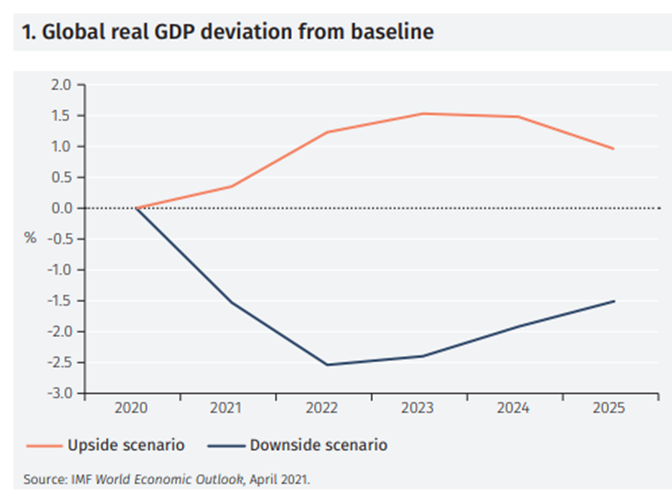
The IMF’s Fiscal Monitor relies on growth projections from the IMF’s World Economic Outlook to forecast the impact on public finances. The latter sets out three scenarios: a baseline, an upside, and a downside. In the upside scenario, an accelerated vaccination campaign raises the level of global GDP by USD9 trillion over the next five years and leads to a faster decline in unemployment than in the baseline (see Figure 1). The downside scenario considers the effects of bottlenecks in the vaccine supply chain leading to delayed herd immunity.
The IMF Fiscal Monitor estimates that in the upside scenario tax revenues would be USD1 trillion higher than baseline through 2025 in developed countries alone, while expenditures would also be much lower. After the expected peak in 2021, debt/GDP ratios would consequently fall faster than in the baseline scenario. A virtuous cycle results in which improved public finances free up resources for the benefit of economic growth with favourable feedback effects on public debt. Vaccines should be seen as a global public good and, according to the IMF, the vaccination campaign could be “the public project with the highest return ever identified”.
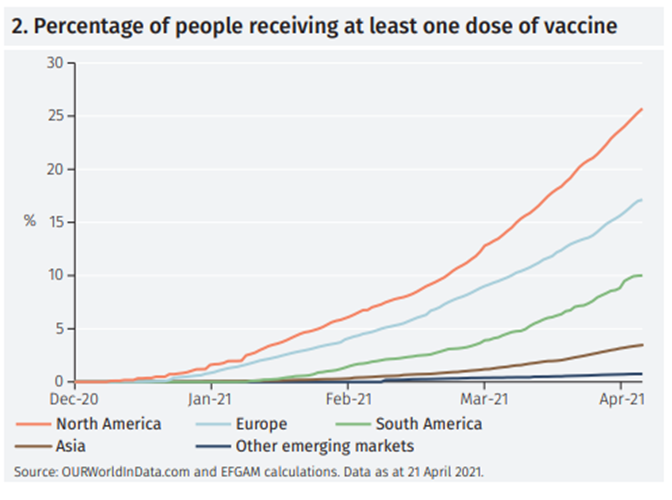
As of 17 April, over a quarter of the North American population and one-sixth of the European population had received at least one dose of a Covid-19 vaccine (see Figure 2). The share of the population vaccinated against the virus is lower elsewhere, with only 10% in South America and less than 4% and 1% of the populations in Asia and Africa respectively receiving at least one dose. Advanced economies therefore have an edge over emerging markets in recovering from the pandemic.
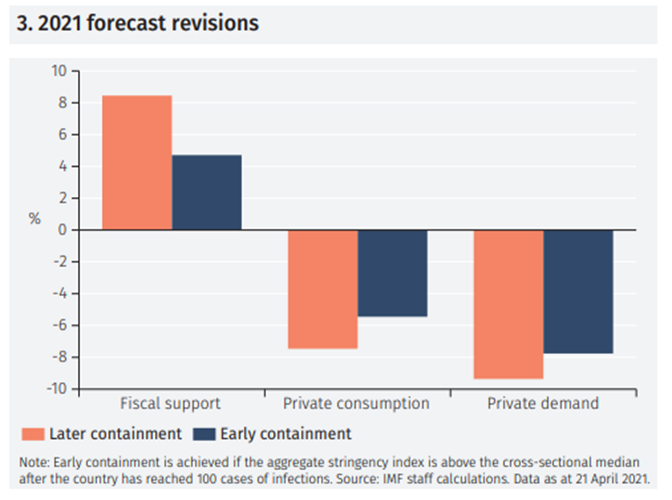
In addition, the Fiscal Monitor stresses that countries need to be decisive in taking potentially unpopular but necessary decisions to defeat the pandemic, safeguard the economy and improve fiscal stability. Considering the experience of last year, the IMF shows that economies where measures to contain the pandemic were adopted most rapidly required lower public deficits than late adopters and saw less pronounced contractions in private consumption and investment (see Figure 3). More generally, the IMF notes the importance of strengthening health systems and social safety nets to increase economic resilience to future pandemic risks.
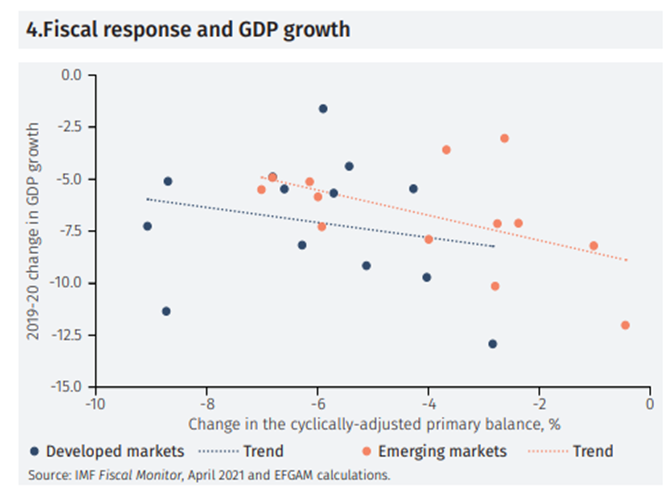
Beyond effectively managing the health care emergency, countries that mobilised the most financial resources to counter its economic effects experienced a less pronounced decline in economic activity (Figure 4). The larger the increase in the cyclically adjusted primary deficit, the smaller the decline in GDP growth in 2020 compared to 2019. The IMF’s recommendation to governments is therefore to maintain stimulative policies in place until the crisis is resolved and economies have fully recovered.
To continue reading please download the full article below.
Important Information
The value of investments and the income derived from them can fall as well as rise, and past performance is no indicator of future performance. Investment products may be subject to investment risks involving, but not limited to, possible loss of all or part of the principal invested.
This document does not constitute and shall not be construed as a prospectus, advertisement, public offering or placement of, nor a recommendation to buy, sell, hold or solicit, any investment, security, other financial instrument or other product or service. It is not intended to be a final representation of the terms and conditions of any investment, security, other financial instrument or other product or service. This document is for general information only and is not intended as investment advice or any other specific recommendation as to any particular course of action or inaction. The information in this document does not take into account the specific investment objectives, financial situation or particular needs of the recipient. You should seek your own professional advice suitable to your particular circumstances prior to making any investment or if you are in doubt as to the information in this document.
Although information in this document has been obtained from sources believed to be reliable, no member of the EFG group represents or warrants its accuracy, and such information may be incomplete or condensed. Any opinions in this document are subject to change without notice. This document may contain personal opinions which do not necessarily reflect the position of any member of the EFG group. To the fullest extent permissible by law, no member of the EFG group shall be responsible for the consequences of any errors or omissions herein, or reliance upon any opinion or statement contained herein, and each member of the EFG group expressly disclaims any liability, including (without limitation) liability for incidental or consequential damages, arising from the same or resulting from any action or inaction on the part of the recipient in reliance on this document.
The availability of this document in any jurisdiction or country may be contrary to local law or regulation and persons who come into possession of this document should inform themselves of and observe any restrictions. This document may not be reproduced, disclosed or distributed (in whole or in part) to any other person without prior written permission from an authorised member of the EFG group.
This document has been produced by EFG Asset Management (UK) Limited for use by the EFG group and the worldwide subsidiaries and affiliates within the EFG group. EFG Asset Management (UK) Limited is authorised and regulated by the UK Financial Conduct Authority, registered no. 7389746. Registered address: EFG Asset Management (UK) Limited, Leconfield House, Curzon Street, London W1J 5JB, United Kingdom, telephone +44 (0)20 7491 9111.