- Date:
With the crisis in Ukraine escalating, there is growing concern that European economies will be affected. GianLuigi Mandruzzato looks at the risks faced by the Swiss economy.
With the crisis in Ukraine escalating, there is growing concern that European economies will be affected. In this Macro Flash Note, GianLuigi Mandruzzato looks at the risks faced by the Swiss economy.
The direct consequences of the conflict on Swiss GDP growth will be limited. In 2021, Russia absorbed only about 1% of Swiss exports and was the source of only 0.4% of Swiss imports. Ukraine was an even smaller trading partner, worth less than 0.2% of Swiss exports and less than 0.1% of Swiss imports (see Chart 1).1
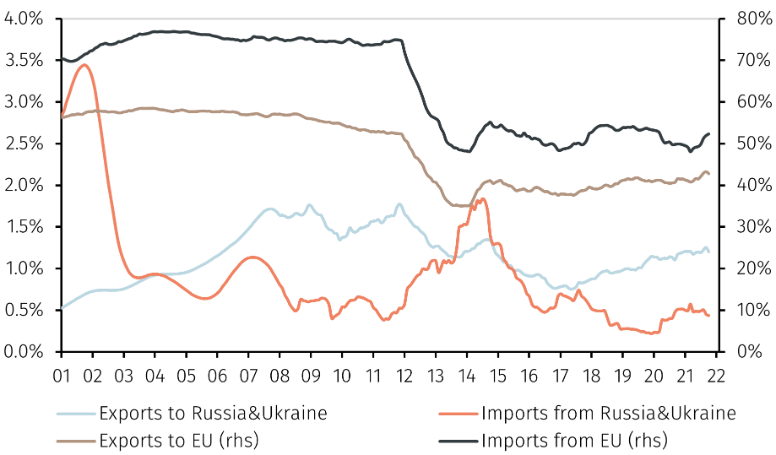
Source: IMF Direction of Trade Statistics, SECO, Refinitiv, and EFGAM calculations.
In comparison, Switzerland trades much more with the countries in the European Union (EU). In 2021, EU countries were the destination of almost 43% of Swiss exports and originated more than 52% of Swiss imports.
Hence, should the war in Ukraine have a meaningful and lasting impact on economic activity in the EU, this would indirectly also impact the Swiss economy. More broadly, as a small open economy, Switzerland is structurally exposed to any shock that affects global trade flows negatively.
The war in Ukraine will also directly affect Swiss prices. If oil prices stay high, the price of petroleum products, which Switzerland mainly imports, would stay high. However, the impact on the general level of prices in Switzerland would be expected to be relatively limited. According to the International Energy Agency, in 2020 oil and petroleum products comprised 34% of total Swiss energy supply, natural gas another 12% and coal less than 0.5% (see Chart 2). In total, the prices of about 46% of Swiss energy sources are affected by the war in the Ukraine and the risk of Russian supplies being restricted.
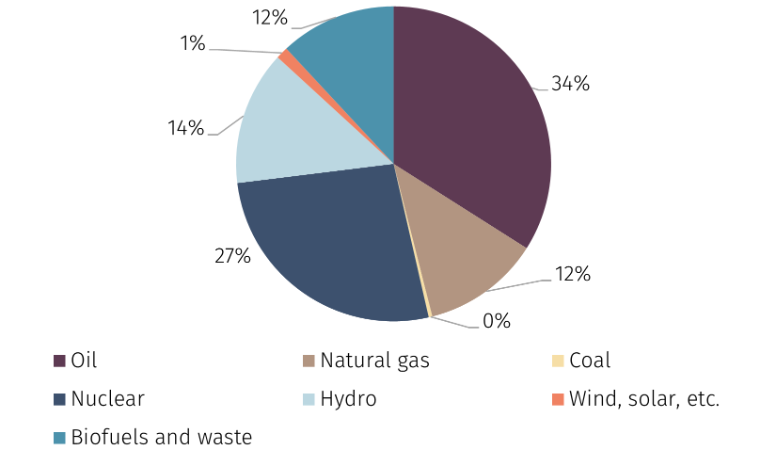
Source: International Energy Agency and EFGAM calculations.
This makes Switzerland less exposed than many other countries to the risks posed by the current crisis and higher energy prices. For comparison, liquid fossil fuels are the source of 57.5% of the total EU energy supply, and coal, also mostly imported from Russia, adds another 13%, for a total of more than 71%.
Furthermore, the impact on Swiss inflation due to higher import prices will most likely be mitigated by the appreciation of the Swiss franc that would be expected if geopolitical tensions escalated further.
In conclusion, the direct impact of the crisis between Russia and Western countries on the Swiss economy is expected to be limited. However, the longer it lasts the higher the chance that growth in the EU, Switzerland’s main trading partner, will slow and that high energy prices will raise Swiss inflation, negatively affecting the Swiss economy.
1 Another channel of transmission of the crisis on Swiss GDP growth is the financial channel: if cross-border banking activities are constrained by sanctions on Russian entities that may impact the activity of the Swiss banking sector, but the impact is hard to evaluate.
Important Information
The value of investments and the income derived from them can fall as well as rise, and past performance is no indicator of future performance. Investment products may be subject to investment risks involving, but not limited to, possible loss of all or part of the principal invested.
This document does not constitute and shall not be construed as a prospectus, advertisement, public offering or placement of, nor a recommendation to buy, sell, hold or solicit, any investment, security, other financial instrument or other product or service. It is not intended to be a final representation of the terms and conditions of any investment, security, other financial instrument or other product or service. This document is for general information only and is not intended as investment advice or any other specific recommendation as to any particular course of action or inaction. The information in this document does not take into account the specific investment objectives, financial situation or particular needs of the recipient. You should seek your own professional advice suitable to your particular circumstances prior to making any investment or if you are in doubt as to the information in this document.
Although information in this document has been obtained from sources believed to be reliable, no member of the EFG group represents or warrants its accuracy, and such information may be incomplete or condensed. Any opinions in this document are subject to change without notice. This document may contain personal opinions which do not necessarily reflect the position of any member of the EFG group. To the fullest extent permissible by law, no member of the EFG group shall be responsible for the consequences of any errors or omissions herein, or reliance upon any opinion or statement contained herein, and each member of the EFG group expressly disclaims any liability, including (without limitation) liability for incidental or consequential damages, arising from the same or resulting from any action or inaction on the part of the recipient in reliance on this document.
The availability of this document in any jurisdiction or country may be contrary to local law or regulation and persons who come into possession of this document should inform themselves of and observe any restrictions. This document may not be reproduced, disclosed or distributed (in whole or in part) to any other person without prior written permission from an authorised member of the EFG group.
This document has been produced by EFG Asset Management (UK) Limited for use by the EFG group and the worldwide subsidiaries and affiliates within the EFG group. EFG Asset Management (UK) Limited is authorised and regulated by the UK Financial Conduct Authority, registered no. 7389746. Registered address: EFG Asset Management (UK) Limited, Leconfield House, Curzon Street, London W1J 5JB, United Kingdom, telephone +44 (0)20 7491 9111.