

- Date:
- Author:
- Sam Jochim
The recent burst of inflation in the US and in many other countries has led investors to wonder whether the entire inflation environment has changed.
The minutes of the latest monetary policy meetings of the Fed, ECB and BoE provide a window into their current thinking. In this Macro Flash Note, Economist Sam Jochim assesses the perceived hawkishness of each central bank with the help of EFGAM’s Hawkishness Indicator.
The EFGAM Hawkishness Indicator (EHI) aims to track the policy bias at central bank meetings. It does so by counting the number of times key terms such as “elevated”, “robust”, “high”, and “strong” are repeated in the published minutes of the meetings. The output is simply the number of times each key term appears.
Despite leaving interest rates unchanged for the second consecutive meeting, the Federal Reserve (Fed) sounded more hawkish in November than it did in September according to the EHI (see Chart 1).
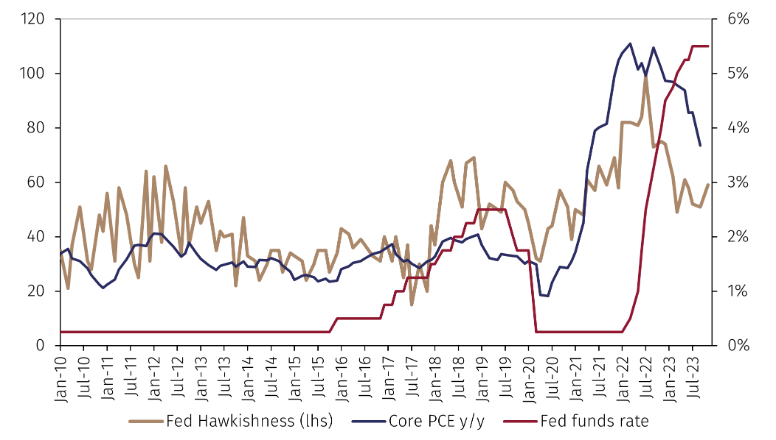
Source: Federal Reserve, LSEG Data & Analytics and EFGAM calculations. Data as at 23 November 2023.
Given the EHI fluctuates from meeting-to-meeting, it is informative to observe its broader trends. A notable relationship is that the EHI for the Fed has a 70% correlation with 12-month core PCE inflation.1
It is therefore unsurprising that the decline in the EHI since July 2022 has been associated with a fall in core PCE inflation. That the EHI for the Fed rose to 59 in November, and remained above its long-term median level of 44, highlights an important point.2 Rates have likely peaked in the US, but while inflation remains significantly above its 2% target, the Fed is likely to continue to talk tough.
The same is true for the European Central Bank (ECB). The minutes from its October meeting also showed an increase in hawkishness according to the EHI, which rose from 89 to 99 (see Chart 2). The inclusion of the statement “It was deemed important for the Governing Council to avoid an unwarranted loosening of financial conditions” highlighted that the central bank was comfortable with markets expecting rates to stay higher for longer while inflation is above the 2% target.3
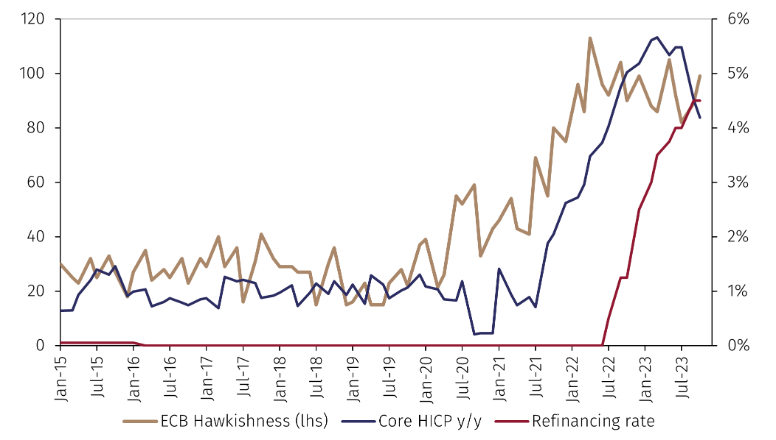
Source: European Central Bank, LSEG Data & Analytics and EFGAM calculations. Data as at 23 November 2023.
While rates have likely also peaked for the ECB, the EHI remained well above its median level of 33.4 The indicator has an 84% correlation with core HICP inflation.5 If the disinflationary trend continues in the eurozone, one might expect the ECB’s tone to soften, and perhaps at a faster pace than for the Fed given the higher starting point.
Interestingly, the EHI for the Bank of England (BoE) declined at its November meeting, falling to 20 and below its long-term median level of 21 (see Chart 3).6 The indicator’s correlation with core CPI inflation is also lower than for the other two central banks, at 47%.7
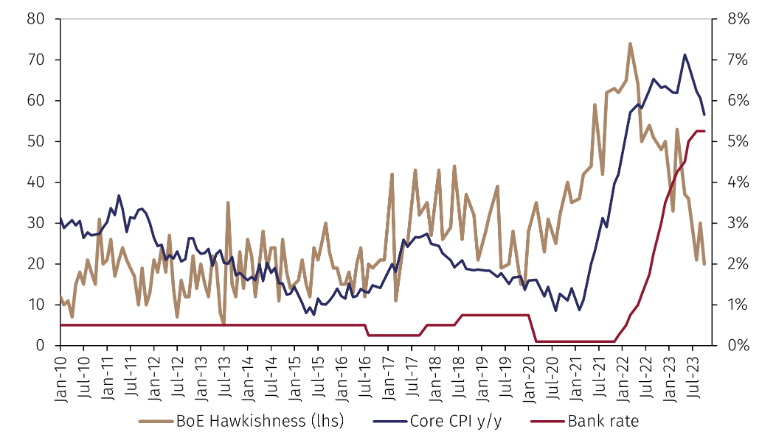
Source: Source: Bank of England, LSEG Data & Analytics and EFGAM calculations. Data as at 23 November 2023.
The lower correlation could highlight the difficulty the Bank has in clearly communicating its thinking, with former and current Governors Mark Carney and Andrew Bailey both being likened to an “unreliable boyfriend”.
Despite the decline in the BoE EHI, which is only based on monetary policy meeting minutes, MPC members have sought to avoid loosening financial conditions in media appearances following the November meeting. Governor Bailey recently noted investors were placing “too much weight” on the sharp decline in inflation in October and that the BoE is “concerned” about the persistence of inflation.8 This highlights that the central bank’s baseline scenario also sees rates staying higher for longer.
In summary, the meeting-to-meeting volatility of the EHIs means that caution should be exercised when interpreting them. While the indicators have declined from their peaks last year, they remain elevated for the Fed and ECB. The EHI for the BoE has declined meaningfully, despite the Bank highlighting its baseline scenario of rates remaining higher for longer. All three central banks have an incentive to talk tough while inflation is high, to avoid financial market conditions easing and undoing some of the inflation fighting impact of higher policy rates.
Important Information
The value of investments and the income derived from them can fall as well as rise, and past performance is no indicator of future performance. Investment products may be subject to investment risks involving, but not limited to, possible loss of all or part of the principal invested.
This document does not constitute and shall not be construed as a prospectus, advertisement, public offering or placement of, nor a recommendation to buy, sell, hold or solicit, any investment, security, other financial instrument or other product or service. It is not intended to be a final representation of the terms and conditions of any investment, security, other financial instrument or other product or service. This document is for general information only and is not intended as investment advice or any other specific recommendation as to any particular course of action or inaction. The information in this document does not take into account the specific investment objectives, financial situation or particular needs of the recipient. You should seek your own professional advice suitable to your particular circumstances prior to making any investment or if you are in doubt as to the information in this document.
Although information in this document has been obtained from sources believed to be reliable, no member of the EFG group represents or warrants its accuracy, and such information may be incomplete or condensed. Any opinions in this document are subject to change without notice. This document may contain personal opinions which do not necessarily reflect the position of any member of the EFG group. To the fullest extent permissible by law, no member of the EFG group shall be responsible for the consequences of any errors or omissions herein, or reliance upon any opinion or statement contained herein, and each member of the EFG group expressly disclaims any liability, including (without limitation) liability for incidental or consequential damages, arising from the same or resulting from any action or inaction on the part of the recipient in reliance on this document.
The availability of this document in any jurisdiction or country may be contrary to local law or regulation and persons who come into possession of this document should inform themselves of and observe any restrictions. This document may not be reproduced, disclosed or distributed (in whole or in part) to any other person without prior written permission from an authorised member of the EFG group.
This document has been produced by EFG Asset Management (UK) Limited for use by the EFG group and the worldwide subsidiaries and affiliates within the EFG group. EFG Asset Management (UK) Limited is authorised and regulated by the UK Financial Conduct Authority, registered no. 7389746. Registered address: EFG Asset Management (UK) Limited, Park House, 116 Park Street, London W1K 6AP, United Kingdom, telephone +44 (0)20 7491 9111.
