

- Date:
- Author:
- GianLuigi Mandruzzato
The recent burst of inflation in the US and in many other countries has led investors to wonder whether the entire inflation environment has changed.
The Swiss National Bank stayed the course on its inflation fight and, despite recent financial sector turmoil, raised rates by 0.50% to 1.50%. The SNB’s language remained more hawkish than expected, reiterating that additional rate increases “cannot be ruled out”.
Furthermore, the central bank said it sold CHF27 billion of foreign currency in 2022Q4 to support the Swiss franc, thereby tightening monetary conditions and limiting imported inflation. The SNB said it will consider again this option to compound the effects of higher interest rates and bring inflation back to target. These comments point to at least another rate increase, possibly in June, although the size of any hike may be reduced.
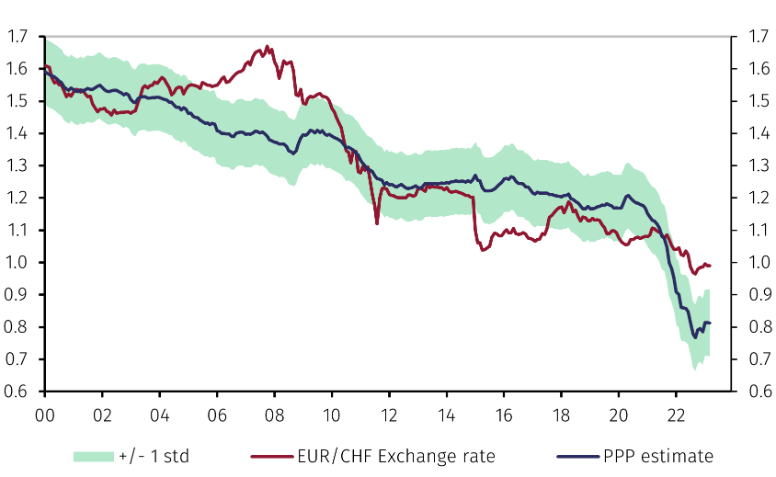
Source: Refinitiv and EFGAM calculations. Data as at 23 March 2023.
The SNB’s hawkishness reflects the upward revision of its conditional inflation forecasts, which now see inflation staying above the 0-2% target range up to the end of 2025. The central bank noted price increases are now “broad-based”, pointing to the risk that the current high level of inflation becomes embedded in private sector expectations.
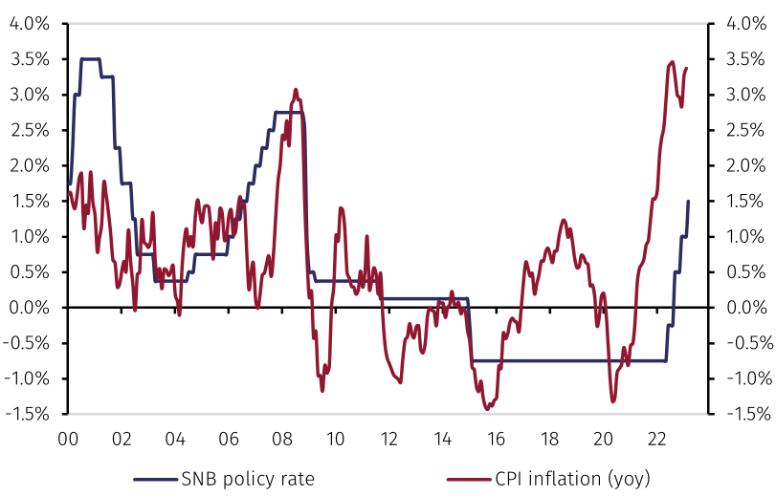
Source: Refinitiv and EFGAM calculations. Data as at 23 March 2023.
Considering the risks to the outlook, the SNB acknowledged that developments in the financial sector increased uncertainty. The central bank’s confidence in the conditional inflation projections is probably lower today than usual and a downside scenario where inflation returns to target in the not too distant future cannot be excluded.
Overall, the SNB decided to separate the fight against inflation from financial stability related issues. On the latter, the central bank is providing ample liquidity to the system. However, financing conditions for the non-financial sector have tightened, reflecting the increased cost of funding for banks, itself a consequence of the turmoil in the financial sector.
Therefore, there is a risk that the SNB’s policy tightening proves too aggressive and causes unnecessary damage to the economy. The challenge for the central bank will be to strike the right balance between fighting inflation and preserving financial stability.
Important Information
The value of investments and the income derived from them can fall as well as rise, and past performance is no indicator of future performance. Investment products may be subject to investment risks involving, but not limited to, possible loss of all or part of the principal invested.
This document does not constitute and shall not be construed as a prospectus, advertisement, public offering or placement of, nor a recommendation to buy, sell, hold or solicit, any investment, security, other financial instrument or other product or service. It is not intended to be a final representation of the terms and conditions of any investment, security, other financial instrument or other product or service. This document is for general information only and is not intended as investment advice or any other specific recommendation as to any particular course of action or inaction. The information in this document does not take into account the specific investment objectives, financial situation or particular needs of the recipient. You should seek your own professional advice suitable to your particular circumstances prior to making any investment or if you are in doubt as to the information in this document.
Although information in this document has been obtained from sources believed to be reliable, no member of the EFG group represents or warrants its accuracy, and such information may be incomplete or condensed. Any opinions in this document are subject to change without notice. This document may contain personal opinions which do not necessarily reflect the position of any member of the EFG group. To the fullest extent permissible by law, no member of the EFG group shall be responsible for the consequences of any errors or omissions herein, or reliance upon any opinion or statement contained herein, and each member of the EFG group expressly disclaims any liability, including (without limitation) liability for incidental or consequential damages, arising from the same or resulting from any action or inaction on the part of the recipient in reliance on this document.
The availability of this document in any jurisdiction or country may be contrary to local law or regulation and persons who come into possession of this document should inform themselves of and observe any restrictions. This document may not be reproduced, disclosed or distributed (in whole or in part) to any other person without prior written permission from an authorised member of the EFG group.
This document has been produced by EFG Asset Management (UK) Limited for use by the EFG group and the worldwide subsidiaries and affiliates within the EFG group. EFG Asset Management (UK) Limited is authorised and regulated by the UK Financial Conduct Authority, registered no. 7389746. Registered address: EFG Asset Management (UK) Limited, Park House, 116 Park Street, London W1K 6AP, United Kingdom, telephone +44 (0)20 7491 9111.
