

- Date:
- Author:
- GianLuigi Mandruzzato
The recent burst of inflation in the US and in many other countries has led investors to wonder whether the entire inflation environment has changed.
Tight financial conditions are needed to restore price stability but constrain growth. Many commentators note that the recent bond and equity market rallies have eased financial conditions. However, central banks focus also on bank lending conditions as it is a critical source of financing, particularly in the eurozone. In this Macro Flash Note, GianLuigi Mandruzzato looks at loan officers' surveys and concludes that financial conditions have continued to tighten significantly.
Central banks have been aggressively raising interest rates to return inflation to levels compatible with price stability.
Many commentators associate tight financial conditions with rising bond yields and falling stock prices. They thus note that recent market rallies have partially offset the efforts of central banks and may force them to raise interest rates further, and for a longer period of time, than previously envisaged.
However, central banks assess financial conditions in broad terms, including the state of bank lending, a critical source of financing for households and non-financial corporates. To help monitor this, central banks survey senior loan officers at commercial banks.1
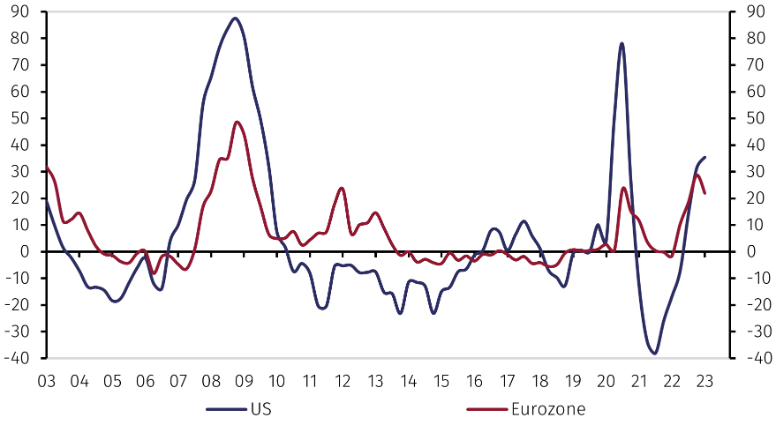
In the first quarter of 2023 commercial banks tightened lending standards significantly, continuing the trend started in 2022 (see Chart 1). In the US the intensity of the restriction was greater than in previous quarters. In the eurozone, despite a slight moderation, the rate of tightening of credit access conditions was higher, for the second consecutive quarter, than the peaks reached after the outbreak of the pandemic and during the European debt crisis.
Source: Refinitiv and EFGAM calculations.
The tightening of lending standards encompasses higher interest rates, smaller loans approved than requested, and the demand for more collateral. These changes reflect both higher monetary policy rates, which raise commercial banks’ cost of financing, as well as banks’ concerns of rising non-performing loans due to the worsened economic outlook.
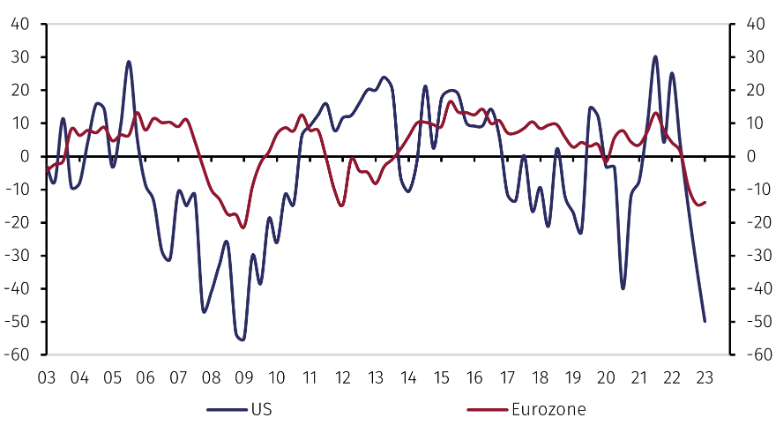
The mirror image of tightening lending standards is a collapse in loan demand, reported to be as intense as in the aftermath of the default of Lehman in September 2008 (see Chart 2). This bodes ill for GDP growth in the coming quarters, particularly in the eurozone where bank lending represents a larger share of private sector financing than in the US. Furthermore, the European Central Bank has signalled that it intends to continue to increase interest rates decisively to curb inflation while the Federal Reserve is seen to be close to ending its monetary policy tightening.
Source: Refinitiv and EFGAM calculations.
To conclude, the senior loan officers' surveys in the US and the eurozone show that in early 2023 commercial banks in developed economies have further tightened lending standards. This shows how the central banks’ actions are causing a significant tightening of financial conditions for the private sector despite the recent market rally. Unsurprisingly, households and non-financial corporates have strongly reduced their demand for loans. The resulting slowdown in fixed investment and house purchases will help ease inflation in the quarters ahead.
1 Every quarter, central banks in major Western countries ask commercial bank loan officers how the conditions applied to private sector loans have changed, how the demand for loans has changed, and which factors have had the greatest impact on these dynamics. This note refers to US and eurozone survey findings, but these are similar to findings in the UK and Japan surveys.
Important Information
The value of investments and the income derived from them can fall as well as rise, and past performance is no indicator of future performance. Investment products may be subject to investment risks involving, but not limited to, possible loss of all or part of the principal invested.
This document does not constitute and shall not be construed as a prospectus, advertisement, public offering or placement of, nor a recommendation to buy, sell, hold or solicit, any investment, security, other financial instrument or other product or service. It is not intended to be a final representation of the terms and conditions of any investment, security, other financial instrument or other product or service. This document is for general information only and is not intended as investment advice or any other specific recommendation as to any particular course of action or inaction. The information in this document does not take into account the specific investment objectives, financial situation or particular needs of the recipient. You should seek your own professional advice suitable to your particular circumstances prior to making any investment or if you are in doubt as to the information in this document.
Although information in this document has been obtained from sources believed to be reliable, no member of the EFG group represents or warrants its accuracy, and such information may be incomplete or condensed. Any opinions in this document are subject to change without notice. This document may contain personal opinions which do not necessarily reflect the position of any member of the EFG group. To the fullest extent permissible by law, no member of the EFG group shall be responsible for the consequences of any errors or omissions herein, or reliance upon any opinion or statement contained herein, and each member of the EFG group expressly disclaims any liability, including (without limitation) liability for incidental or consequential damages, arising from the same or resulting from any action or inaction on the part of the recipient in reliance on this document.
The availability of this document in any jurisdiction or country may be contrary to local law or regulation and persons who come into possession of this document should inform themselves of and observe any restrictions. This document may not be reproduced, disclosed or distributed (in whole or in part) to any other person without prior written permission from an authorised member of the EFG group.
This document has been produced by EFG Asset Management (UK) Limited for use by the EFG group and the worldwide subsidiaries and affiliates within the EFG group. EFG Asset Management (UK) Limited is authorised and regulated by the UK Financial Conduct Authority, registered no. 7389746. Registered address: EFG Asset Management (UK) Limited, Park House, 116 Park Street, London W1K 6AP, United Kingdom, telephone +44 (0)20 7491 9111.
