- Date:
Infocus - For some time, consumers around the world have been affected by shortages of goods, from basic necessities to microchips. At the same time, concerns about inflation have grown.
In this Macro Flash Note, EFG chief economist Stefan Gerlach explains why the oil price increases observed in recent weeks are less worrisome than those observed in 1974 when the world economy was ravaged by the first oil shock.
Rising oil prices are causing widespread concerns about stagflation among investors. Yet it is important to have in mind that oil consumption is much less important to the global economy now than in the 1970s when oil price increases caused surging inflation, deep recessions and collapsing stock markets.
To see this, the graph below shows US consumption of crude oil, divided by US real GDP. It can be thought of as measuring how much crude oil is needed to generate one unit of real GDP. The index fell from 100 in 1973, the year before the devastating oil shock of 1974, to 34 in 2021. The point is clear: the US economy now uses 1/3 of the amount oil it needed in 1973 to produce one unit of output. (Similar relationships hold for other economies.) Since less oil is needed, production costs, and therefore inflation, will be less impacted by oil price increases than in the 1970s.
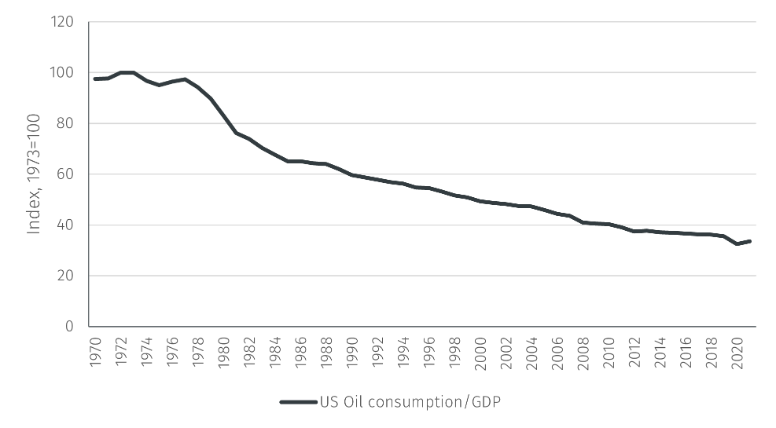
Source: U.S. Energy Information Administration and FRED. Data as of 8 March 2022.
Furthermore, the increase in oil prices is still much smaller than the increase in oil prices in 1974 when they rose 168%.1 Given an average price in 2021 of West Texas Intermediate crude oil of USD 67.99 per barrel, the annual average price in 2022 would have to rise to USD 182 per barrel for the increase to be equally large as in 1974; at the time of writing, they are fluctuating around USD 120 per barrel. While this increase is large (78%) it doesn’t come close to the increases observed in 1974.
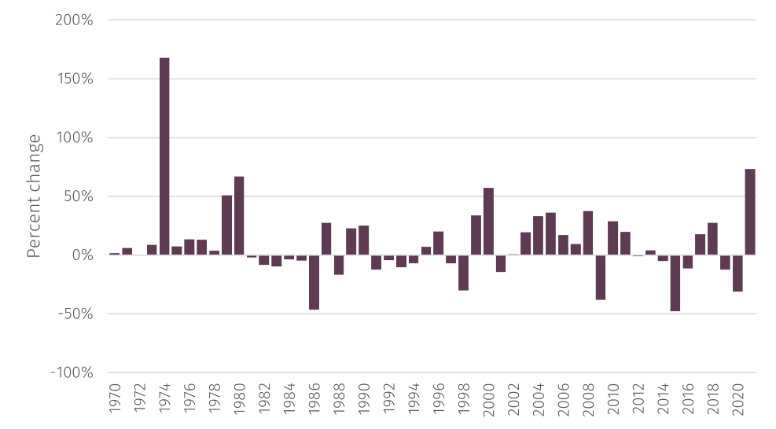
Source: FRED, data as of 8 March 2022.
There is no denying that recent oil price increases constitute a severe challenge to economic growth and inflation in the US and elsewhere in the world economy. However, modern economies require much less oil per unit of output than they did 50 years ago, and the price increases are to date much smaller than those in 1974. Thus, the risks to the economic outlook, while significant, are much smaller now than in 1974.
1 This increase is computed using the yearly averages of the price of West Texas Intermediate crude.
Important Information
The value of investments and the income derived from them can fall as well as rise, and past performance is no indicator of future performance. Investment products may be subject to investment risks involving, but not limited to, possible loss of all or part of the principal invested.
This document does not constitute and shall not be construed as a prospectus, advertisement, public offering or placement of, nor a recommendation to buy, sell, hold or solicit, any investment, security, other financial instrument or other product or service. It is not intended to be a final representation of the terms and conditions of any investment, security, other financial instrument or other product or service. This document is for general information only and is not intended as investment advice or any other specific recommendation as to any particular course of action or inaction. The information in this document does not take into account the specific investment objectives, financial situation or particular needs of the recipient. You should seek your own professional advice suitable to your particular circumstances prior to making any investment or if you are in doubt as to the information in this document.
Although information in this document has been obtained from sources believed to be reliable, no member of the EFG group represents or warrants its accuracy, and such information may be incomplete or condensed. Any opinions in this document are subject to change without notice. This document may contain personal opinions which do not necessarily reflect the position of any member of the EFG group. To the fullest extent permissible by law, no member of the EFG group shall be responsible for the consequences of any errors or omissions herein, or reliance upon any opinion or statement contained herein, and each member of the EFG group expressly disclaims any liability, including (without limitation) liability for incidental or consequential damages, arising from the same or resulting from any action or inaction on the part of the recipient in reliance on this document.
The availability of this document in any jurisdiction or country may be contrary to local law or regulation and persons who come into possession of this document should inform themselves of and observe any restrictions. This document may not be reproduced, disclosed or distributed (in whole or in part) to any other person without prior written permission from an authorised member of the EFG group.
This document has been produced by EFG Asset Management (UK) Limited for use by the EFG group and the worldwide subsidiaries and affiliates within the EFG group. EFG Asset Management (UK) Limited is authorised and regulated by the UK Financial Conduct Authority, registered no. 7389746. Registered address: EFG Asset Management (UK) Limited, Leconfield House, Curzon Street, London W1J 5JB, United Kingdom, telephone +44 (0)20 7491 9111.