

- Date:
- Author:
- Stefan Gerlach
The recent burst of inflation in the US and in many other countries has led investors to wonder whether the entire inflation environment has changed.
In this Macro Flash Note, EFG chief economist Stefan Gerlach reviews the recent release of US labour market data that showed the economy added 517k jobs in January. While the labour market is undoubtedly strong, it seems likely that part of this increase may be due to the annual change in the seasonality factors.
On 3 February, the US Bureau of Labor Statistics (BLS) released its report on The Employment Situation for January 2023. The punchline of the report was that the US labour market remained strong and seemingly unaffected by the progressive and sharp tightening in monetary policy that the Federal Reserve started in March 2022. Strikingly, the unemployment rate fell to 3.4%, the lowest rate recorded since 1969, from 3.5% in December.
Several other key measures of the state of US labour markets remained unchanged (after removing the effects of some annual adjustments to the data). These include the labour force participation rate, which remained at 62.4%, and the employment-population rate, which stayed at 60.2%. Nevertheless, these ratios are below their pre-Covid levels of 63.3% and 61.1%, respectively. The US labour market has in that sense not fully recovered from the pandemic.
There was much attention focussed on the non-farm payroll data, which showed that 517k new jobs were created in the month. These data, which stem from the Establishment survey, were revised following the annual benchmarking process. The new data shows that the US labour market generated 300k more jobs in 2022 than initially estimated.
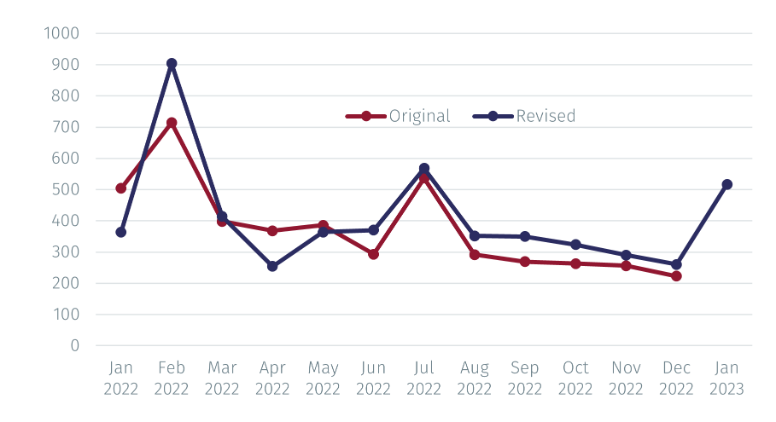
Source: BLS. Data as of 03 February 2023.
The increase in employment by 517k jobs in January is exceptionally large. While the labour market is undoubtedly strong, it seems likely that part of this increase may be a statistical artifact.
One possible explanation is that the seasonal adjustment factors were updated in January. Perhaps surprisingly, seasonal fluctuations in many economic time series often dwarf the non-seasonal component that is of interest to commentators.
The figure below shows that employment (not seasonally adjusted) normally falls by about 2.5 million in January following the busy end-of-year season. Indeed, the variability of employment growth in the seasonally unadjusted data (as captured by the standard deviation) is about seven times larger than the variability of the seasonally adjusted data. A small misestimate of the seasonal factors can therefore have a very large impact on the seasonally adjusted data on employment growth in January.
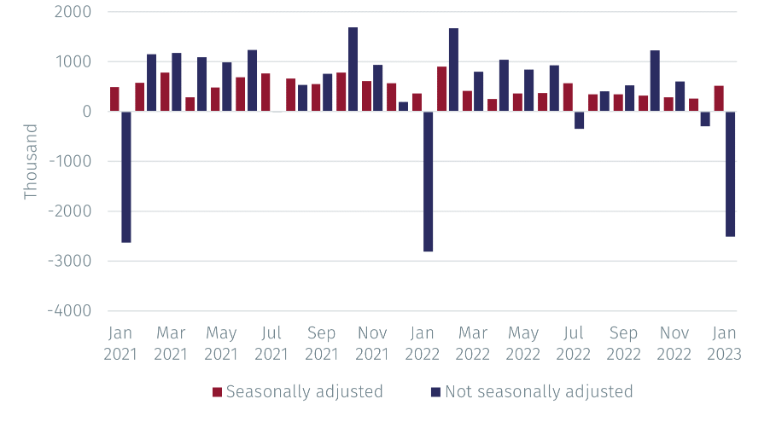
Source: BLS. Data as of 03 February 2023.
To see how critical the seasonal adjustment is, the figure below shows the difference between the seasonally adjusted and the unadjusted data for the increase in non-farm payrolls in January for each year between 2000 and 2023.
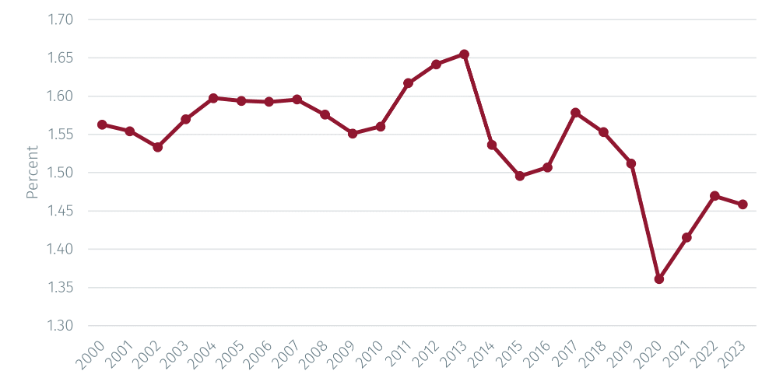
Source: EFG calculations on data from BLS Data as of 03 February 2023.
The seasonal adjustment involves estimating and removing a seasonal factor, which is uncertain and can vary over time. The figure shows that the estimated seasonal factor increased the January data by between 1.35% and 1.65% in the period considered. With total non-farm payrolls around 155 million, an error of 0.1% translates into a miscalculation of 155k of the estimated increase in non-farm payrolls. While there is little doubt that the US economy generated more jobs in January, it makes sense to be a little cautious about the exact increase in payrolls until more data are available.
Important Information
The value of investments and the income derived from them can fall as well as rise, and past performance is no indicator of future performance. Investment products may be subject to investment risks involving, but not limited to, possible loss of all or part of the principal invested.
This document does not constitute and shall not be construed as a prospectus, advertisement, public offering or placement of, nor a recommendation to buy, sell, hold or solicit, any investment, security, other financial instrument or other product or service. It is not intended to be a final representation of the terms and conditions of any investment, security, other financial instrument or other product or service. This document is for general information only and is not intended as investment advice or any other specific recommendation as to any particular course of action or inaction. The information in this document does not take into account the specific investment objectives, financial situation or particular needs of the recipient. You should seek your own professional advice suitable to your particular circumstances prior to making any investment or if you are in doubt as to the information in this document.
Although information in this document has been obtained from sources believed to be reliable, no member of the EFG group represents or warrants its accuracy, and such information may be incomplete or condensed. Any opinions in this document are subject to change without notice. This document may contain personal opinions which do not necessarily reflect the position of any member of the EFG group. To the fullest extent permissible by law, no member of the EFG group shall be responsible for the consequences of any errors or omissions herein, or reliance upon any opinion or statement contained herein, and each member of the EFG group expressly disclaims any liability, including (without limitation) liability for incidental or consequential damages, arising from the same or resulting from any action or inaction on the part of the recipient in reliance on this document.
The availability of this document in any jurisdiction or country may be contrary to local law or regulation and persons who come into possession of this document should inform themselves of and observe any restrictions. This document may not be reproduced, disclosed or distributed (in whole or in part) to any other person without prior written permission from an authorised member of the EFG group.
This document has been produced by EFG Asset Management (UK) Limited for use by the EFG group and the worldwide subsidiaries and affiliates within the EFG group. EFG Asset Management (UK) Limited is authorised and regulated by the UK Financial Conduct Authority, registered no. 7389746. Registered address: EFG Asset Management (UK) Limited, Park House, 116 Park Street, London W1K 6AP, United Kingdom, telephone +44 (0)20 7491 9111.
