

- Date:
- Author:
- Stefan Gerlach
The recent burst of inflation in the US and in many other countries has led investors to wonder whether the entire inflation environment has changed.
Following recent declines in the consumer price index (CPI), much attention focused on the release of the personal consumption expenditures (PCE) price indices for August. EFG Chief Economist Stefan Gerlach looks at what the data tell us in this Macro Flash Note.
The release of PCE inflation1 for August will have disappointed the Fed. Headline PCE inflation fell to 6.2% year-on-year (y/y) in August (0.3% month-on-month) after falling to 6.4% in July (0.1% m/m). Year-on-year, goods prices rose 8.6%, services prices increased by 5.0%, food prices increased 12.4% and energy prices were up 24.7%. This is the second month in a row that headline PCE inflation has declined. However, core PCE inflation rose to 4.9% y/y (0.6% m/m) after falling to 4.6% in July (0.1% m/m). The Fed views core PCE inflation as particularly informative about underlying inflation pressures and will be concerned by this increase. In our view, these data boost the likelihood that the Fed will continue to raise interest rates in its coming meetings.
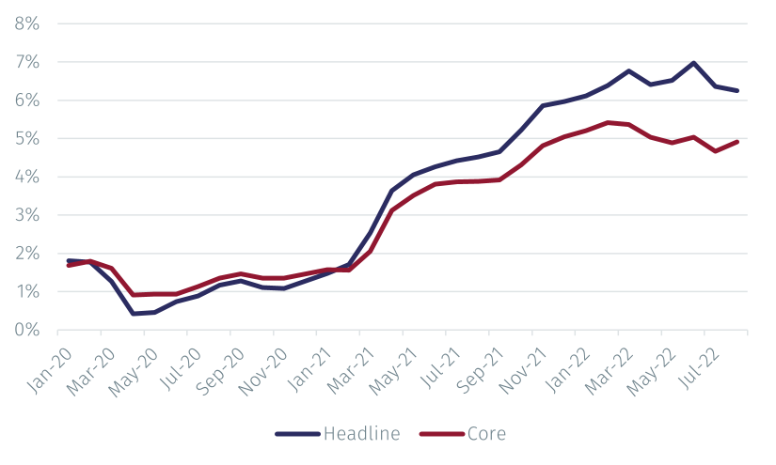
Source: BEA, data as of 30 September 2022.
Prior to 2000, the Federal Open Market Committee focused on CPI inflation but, following an extensive review, decided to change2 to PCE inflation. PCE is normally below CPI inflation because of differences in how the indices are constructed. There are three main differences.3
The first concerns the weights applied to different goods. While the CPI is based on surveys of household purchases, the PCE is based on surveys of what businesses are selling.
The second concerns the coverage or scope of the indices. The CPI covers out-of-pocket expenditures on goods and services purchased but excludes other expenditures that are not paid for directly, for example, medical care. These are included in the PCE.
The third difference arises from how the indices account for changes in the basket. While the PCE accounts for substitution between goods when relative prices change, the CPI updates the basket regularly.
Despite falling in August, PCE inflation remains too high for the Federal Reserve to feel comfortable that inflation is returning towards 2%. Hence, there is a high probability that the Fed will again raise rates forcefully at its next meeting on 2 November.
1 https://www.bea.gov/news/2022/personal-income-and-outlays-august-2022-and-annual-update
2 http://www.federalreserve.gov/boarddocs/hh/2000/February/FullReport.pdf
3 https://www.clevelandfed.org/newsroom-and-events/publications/economic-trends/2014-economic-trends/et-20140417-pce-and-cpi-inflation-whats-the-difference.aspx
Important Information
The value of investments and the income derived from them can fall as well as rise, and past performance is no indicator of future performance. Investment products may be subject to investment risks involving, but not limited to, possible loss of all or part of the principal invested.
This document does not constitute and shall not be construed as a prospectus, advertisement, public offering or placement of, nor a recommendation to buy, sell, hold or solicit, any investment, security, other financial instrument or other product or service. It is not intended to be a final representation of the terms and conditions of any investment, security, other financial instrument or other product or service. This document is for general information only and is not intended as investment advice or any other specific recommendation as to any particular course of action or inaction. The information in this document does not take into account the specific investment objectives, financial situation or particular needs of the recipient. You should seek your own professional advice suitable to your particular circumstances prior to making any investment or if you are in doubt as to the information in this document.
Although information in this document has been obtained from sources believed to be reliable, no member of the EFG group represents or warrants its accuracy, and such information may be incomplete or condensed. Any opinions in this document are subject to change without notice. This document may contain personal opinions which do not necessarily reflect the position of any member of the EFG group. To the fullest extent permissible by law, no member of the EFG group shall be responsible for the consequences of any errors or omissions herein, or reliance upon any opinion or statement contained herein, and each member of the EFG group expressly disclaims any liability, including (without limitation) liability for incidental or consequential damages, arising from the same or resulting from any action or inaction on the part of the recipient in reliance on this document.
The availability of this document in any jurisdiction or country may be contrary to local law or regulation and persons who come into possession of this document should inform themselves of and observe any restrictions. This document may not be reproduced, disclosed or distributed (in whole or in part) to any other person without prior written permission from an authorised member of the EFG group.
This document has been produced by EFG Asset Management (UK) Limited for use by the EFG group and the worldwide subsidiaries and affiliates within the EFG group. EFG Asset Management (UK) Limited is authorised and regulated by the UK Financial Conduct Authority, registered no. 7389746. Registered address: EFG Asset Management (UK) Limited, Park House, 116 Park Street, London W1K 6AP, United Kingdom, telephone +44 (0)20 7491 9111.
