

- Date:
- Author:
- Stefan Gerlach
The recent burst of inflation in the US and in many other countries has led investors to wonder whether the entire inflation environment has changed.
High and persistent services inflation in the US has prevented overall inflation from returning to the Federal Reserve’s 2% objective. In response, the Fed has postponed interest rate cuts. To assess the prospects for services inflation, in this Macro Flash Note EFG Chief Economist Stefan Gerlach looks at the behaviour of consumption spending on services.
US services inflation as measured by the personal consumption expenditure (PCE) index has remained robust, peaking at 6.0% year-on-year in January - February 2023 and declining only to 3.9% in May 2024. Since services are a large part of household consumption, it has prevented overall inflation from returning to the Fed’s 2% inflation objective (Figure 1). In turn, this has led the Federal Open Market Committee to postpone cutting interest rates.
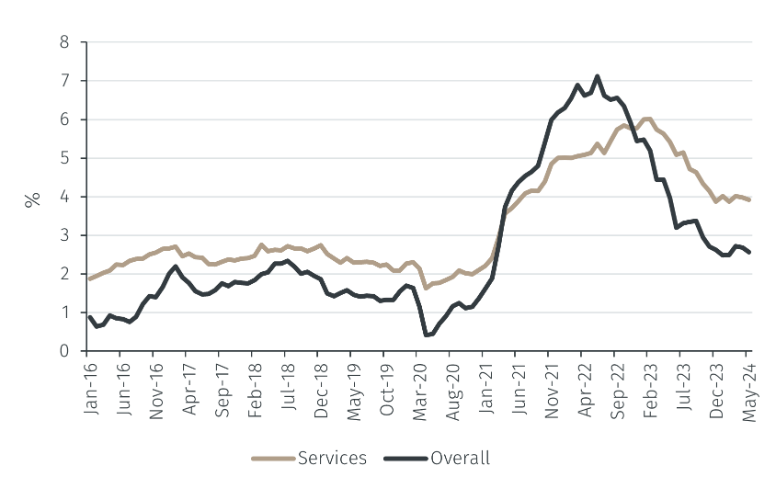
Source: FRED. Data as at 28 June 2024.
Why has services inflation stayed so high? To address this question, it is useful to look at the behaviour of consumer spending on services.
The figure below shows the proportion of consumer spending associated with services. It has been gradually increasing over time, peaking at 69.0% in January 2020 as the Covid pandemic started.
With households worried about contracting Covid and with restaurants, bars and similar institutions subject to lockdowns of varying degrees of severity, consumer spending on services fell sharply, reaching 64.8% of the total in March 2021. It has since started to recover but stood at 67.7% in May 2024.
While it is difficult to determine exactly what the “normal” level of consumption spending on services should be, the figure shows a simple linear trend, estimated over the period 1995-2019. This serves a means of ascertaining whether today’s spending on services is high or low relative to that trend. The rough estimate it provides suggests a normal level of 69.9%. If so, consumption spending on services as a fraction of overall consumer spending was a little more than 2% lower than normal. That implies that consumer spending on services has not yet recovered fully after the pandemic and that services inflation may remain high for some time to come. If so, the Fed may delay interest rate cuts for longer than is currently expected.
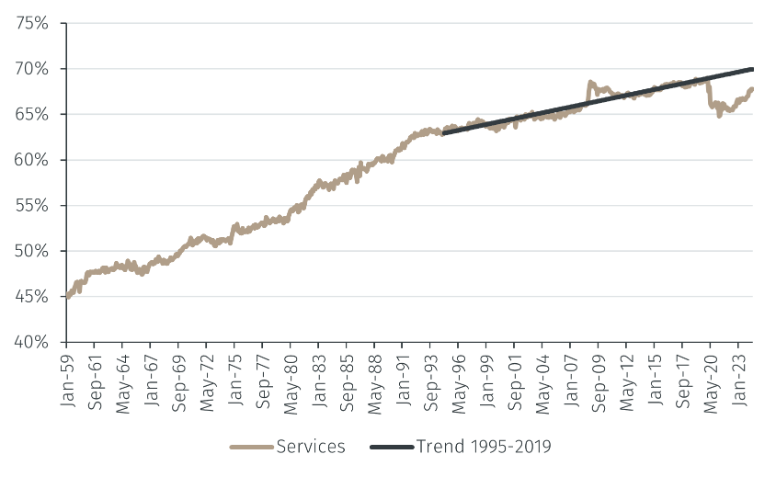
Source: EFGAM calculations on data from FRED. Data as at 28 June 2024.
Important Information
The value of investments and the income derived from them can fall as well as rise, and past performance is no indicator of future performance. Investment products may be subject to investment risks involving, but not limited to, possible loss of all or part of the principal invested.
This document does not constitute and shall not be construed as a prospectus, advertisement, public offering or placement of, nor a recommendation to buy, sell, hold or solicit, any investment, security, other financial instrument or other product or service. It is not intended to be a final representation of the terms and conditions of any investment, security, other financial instrument or other product or service. This document is for general information only and is not intended as investment advice or any other specific recommendation as to any particular course of action or inaction. The information in this document does not take into account the specific investment objectives, financial situation or particular needs of the recipient. You should seek your own professional advice suitable to your particular circumstances prior to making any investment or if you are in doubt as to the information in this document.
Although information in this document has been obtained from sources believed to be reliable, no member of the EFG group represents or warrants its accuracy, and such information may be incomplete or condensed. Any opinions in this document are subject to change without notice. This document may contain personal opinions which do not necessarily reflect the position of any member of the EFG group. To the fullest extent permissible by law, no member of the EFG group shall be responsible for the consequences of any errors or omissions herein, or reliance upon any opinion or statement contained herein, and each member of the EFG group expressly disclaims any liability, including (without limitation) liability for incidental or consequential damages, arising from the same or resulting from any action or inaction on the part of the recipient in reliance on this document.
The availability of this document in any jurisdiction or country may be contrary to local law or regulation and persons who come into possession of this document should inform themselves of and observe any restrictions. This document may not be reproduced, disclosed or distributed (in whole or in part) to any other person without prior written permission from an authorised member of the EFG group.
This document has been produced by EFG Asset Management (UK) Limited for use by the EFG group and the worldwide subsidiaries and affiliates within the EFG group. EFG Asset Management (UK) Limited is authorised and regulated by the UK Financial Conduct Authority, registered no. 7389746. Registered address: EFG Asset Management (UK) Limited, Park House, 116 Park Street, London W1K 6AP, United Kingdom, telephone +44 (0)20 7491 9111.
