- Date:
How has the war in Ukraine impacted the outlook for interest rate increases in the US? In this Macro Flash Note, EFG Chief economist Stefan Gerlach looks at how market expectations have evolved.
How has the war in Ukraine impacted the outlook for interest rate increases in the US? In this Macro Flash Note, EFG Chief economist Stefan Gerlach looks at how market expectations have evolved.
The war in Ukraine will have two offsetting effects on the economy and will therefore complicate the setting of monetary policy. First, the war will push up energy prices, and most likely also food prices, boosting inflation across the world. While this price-level shock will cause inflation to rise only temporarily (but for at least 12 months until it drops out of the year-over-year calculation), central banks will be concerned about the possibility of inflation remaining elevated or rising even higher. That would encourage central banks to tighten monetary policy more rapidly than otherwise.
Secondly, however, higher prices will negatively impact consumers’ spending power and raise production costs for firms, slowing the economy. To mitigate these effects, more expansionary monetary policy would normally be warranted.
Of course, how central banks should respond depends on the extent to which prices are pushed up by these developments and for how long prices will stay high. This is unclear at present. Central banks will therefore do little in the near term, focusing on understanding the incoming macroeconomic data and assessing how the global inflation and business cycle outlook has changed. It is unlikely that they will adopt any new monetary policy initiatives before they have completed this assessment.
The figure below shows how market expectations regarding the outcome of the March FOMC meeting have evolved since the beginning of January. These probabilities are calculated by the Chicago Mercantile Exchange, using prices of various financial instruments. On 3 January markets were pricing in a 39% probability that there would be no change in interest rates in March, a 57% probability to the Fed raising interest rates by 25 basis points and a four percent probability that the Fed would raise interest rates by 50 basis points.
By the beginning of February markets had come to expect tighter monetary policy, attaching a 92% probability to the Fed raising interest rates by 25 basis points and an 8% probability that the Fed would raise interest rates by 50 basis points. As inflation continued to rise, markets started to price in more rapid Fed tightening. By 14 February, markets attached a 39% probability to the Fed raising interest rates by 25 basis points and a 61% probability to the Fed raising them by 50 basis points.
The war in Ukraine has encouraged market participants to revise down their outlook for US monetary policy. By the time of the last observation, which is for 25 February, market participants attached a 76% probability of a 25 basis point federal funds rate increase at the March FOMC meeting and a 24% probability of an increase of 50 basis points.
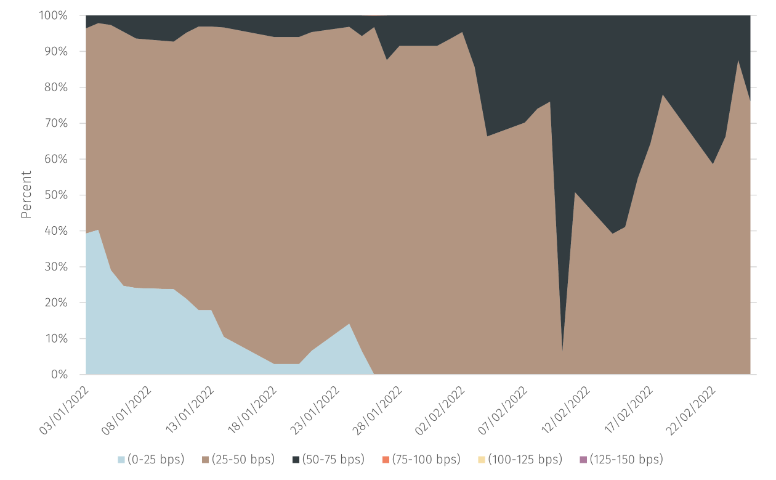
Source: Chicago Mercantile Exchange, data as of 26 February 2022.
Interestingly, and as shown in the graph below, looking at market expectations for the outcome of the December 2022 FOMC meeting there is much less evidence of recent change in market expectations. This suggests that the war in Ukraine is not expected to impact Fed policy at that horizon.
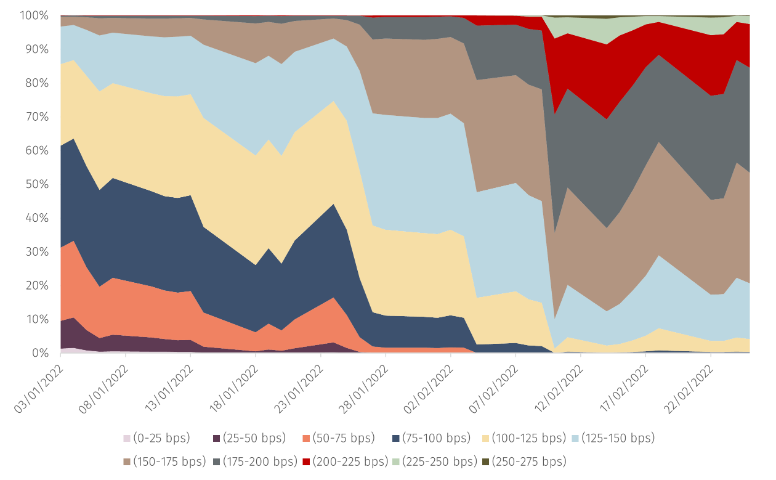
Source: Chicago Mercantile Exchange, data as of 26 February 2022.
In brief, the war in Ukraine has led market participants to scale back their expectations of the Fed raising interest rates at its meeting in March but has had little effect on expectations regarding the outcome of the December meeting.
Figure 3 summarises market pricing for the March and December meetings. Thus, in March markets attach about 3/4 probability of a 25 basis point increase and 1/4 probability to a 50 basis point increase.
For December, the market is pricing in a federal funds rate in the range of 1.50-1.75, that is, six 25 basis points increases from today. That said, the market appears to attach a 31% probability to seven increases.
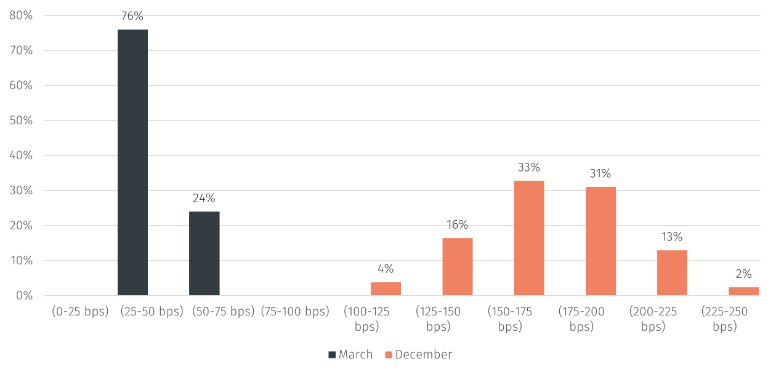
Source: EFG calculations on data from Chicago Mercantile Exchange, data as of 26 February 2022.
Important Information
The value of investments and the income derived from them can fall as well as rise, and past performance is no indicator of future performance. Investment products may be subject to investment risks involving, but not limited to, possible loss of all or part of the principal invested.
This document does not constitute and shall not be construed as a prospectus, advertisement, public offering or placement of, nor a recommendation to buy, sell, hold or solicit, any investment, security, other financial instrument or other product or service. It is not intended to be a final representation of the terms and conditions of any investment, security, other financial instrument or other product or service. This document is for general information only and is not intended as investment advice or any other specific recommendation as to any particular course of action or inaction. The information in this document does not take into account the specific investment objectives, financial situation or particular needs of the recipient. You should seek your own professional advice suitable to your particular circumstances prior to making any investment or if you are in doubt as to the information in this document.
Although information in this document has been obtained from sources believed to be reliable, no member of the EFG group represents or warrants its accuracy, and such information may be incomplete or condensed. Any opinions in this document are subject to change without notice. This document may contain personal opinions which do not necessarily reflect the position of any member of the EFG group. To the fullest extent permissible by law, no member of the EFG group shall be responsible for the consequences of any errors or omissions herein, or reliance upon any opinion or statement contained herein, and each member of the EFG group expressly disclaims any liability, including (without limitation) liability for incidental or consequential damages, arising from the same or resulting from any action or inaction on the part of the recipient in reliance on this document.
The availability of this document in any jurisdiction or country may be contrary to local law or regulation and persons who come into possession of this document should inform themselves of and observe any restrictions. This document may not be reproduced, disclosed or distributed (in whole or in part) to any other person without prior written permission from an authorised member of the EFG group.
This document has been produced by EFG Asset Management (UK) Limited for use by the EFG group and the worldwide subsidiaries and affiliates within the EFG group. EFG Asset Management (UK) Limited is authorised and regulated by the UK Financial Conduct Authority, registered no. 7389746. Registered address: EFG Asset Management (UK) Limited, Leconfield House, Curzon Street, London W1J 5JB, United Kingdom, telephone +44 (0)20 7491 9111.